



If you have been day trading for any length of time, you know the morning session is a battlefield. It is where the volatility is, where the volume is, and frankly, where the money is.
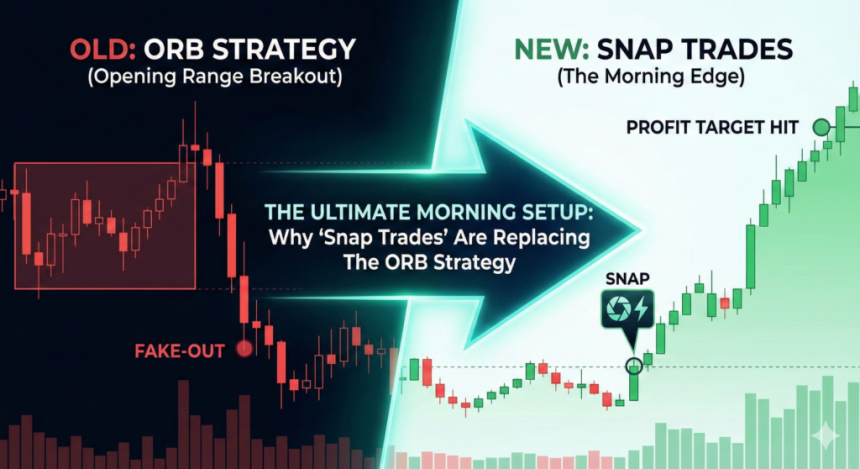
For decades, the “go-to” strategy for morning volatility has been the Opening Range Breakout (ORB). The premise is simple: mark the high and low of the first 15 or 30 minutes, and buy the breakout. It sounds great on paper. But in today’s algorithmic-heavy markets, the ORB has become a trap.
It is plagued by “fake-outs,” wicks that stop you out instantly, and choppy price action that drains your account before 10:30 AM.
It is time to evolve.
We are seeing a shift toward a more precision-based morning strategy we call “Snap Trades.” It is not about guessing the direction of the breakout; it’s about waiting for a specific algorithmic confirmation that “snaps” the price into a high-probability trend.
In this guide, we are going to break down exactly what the Snap Trade strategy is, why it is superior to the traditional ORB, and show you real-world data including 83% win rates on major tickers proving why this should be your new morning routine.
The Problem with the “ORB” (And Why You Keep Getting Stopped Out)

The Opening Range Breakout was popularized in an era when markets moved slower. Today, High-Frequency Trading (HFT) algorithms know exactly where retail traders place their buy stops above the opening range.
Here is the typical ORB scenario:
- The Bait: SPY breaks the 15-minute high. You enter Long.
- The Trap: The price pushes up for 30 seconds, then violently reverses (the “fake-out”).
- The Loss: You get stopped out for a loss.
- The Regret: Ten minutes later, the stock actually does go up, but you are already out of the trade.
The ORB relies on raw price levels. Snap Trades rely on momentum confirmation.
The Solution: The “Snap Trade” Strategy
The Snap Trade is designed to filter out the morning noise. Instead of buying a blind breakout, we are looking for a proprietary “Snap” signal which is a specific alignment of price action and momentum that signals the real move is beginning.
When a Snap signal fires, it usually indicates that the initial battle between bulls and bears is over, and a clear winner has emerged.
Why Snap Trades Beat ORB:
- Defined Risk/Reward: Unlike ORB, where stop losses can be vague (often “low of the day”), Snap Trades create a clear “box” of risk. You know exactly where your stop is and where your target is before you enter.
- Higher Win Rate: By waiting for the “Snap” confirmation rather than the raw breakout, we avoid the majority of morning fake-outs.
- Sector Agnostic: As you will see in our data below, this works on Tech (TSLA), Retail (HD), and Health (UNH) alike.
Anatomy of a Snap Trade: Real-World Examples
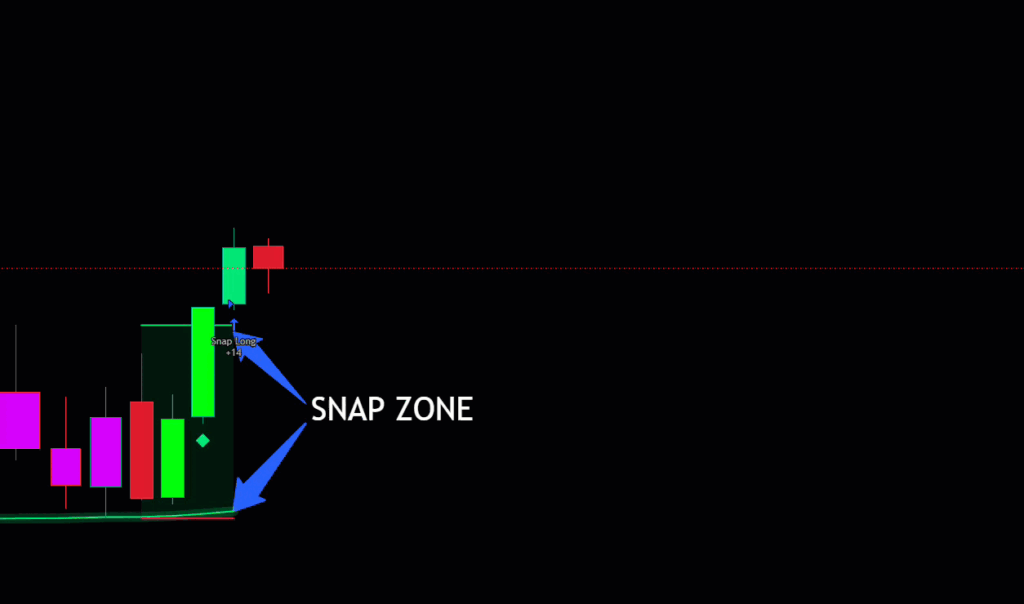
Let’s look at what this actually looks like on the chart. The following examples show the Snap Trade in action during recent sessions.
Example 1: The SPY Long (+19% Gain)

In this setup on the SPY (S&P 500 ETF), we see the difference between a random entry and a Snap entry.
The Breakdown:
- The Entry: Notice we didn’t just buy the first green candle. We waited for the “Snap Long” signal (marked by the blue arrow and teal indicator). This occurred after a period of consolidation, ensuring we weren’t chasing a gap up.
- The Execution: The entry triggered around the 694.40 level.
- The Exit: The strategy provided a clear exit signal at the top of the extension, locking in a +19% gain (on options premiums) before the market could pull back.
Example 2: The QQQ Trend Catch (+20% Gain)
The QQQ (Nasdaq-100) is notoriously choppy in the morning. An ORB trader likely would have been chopped up by the red candles prior to the move.

The Breakdown:
- Precision: The Snap signal identified the exact moment buyers stepped in with conviction.
- Trend Riding: Notice how the price respected the “Green Box” (the support zone created by the Snap strategy). As long as price holds that zone, the trade is valid.
- Result: A clean run-up for a +20% gain.
Example 3: AAPL Morning Reversal (+17% Gain)
Apple can often be sluggish, but the Snap strategy identified a high-momentum burst.

The Breakdown:
- The Setup: AAPL started the morning with indecision. The Snap Long triggered once the price action confirmed a breakout from the lower range.
- The Discipline: The strategy kept us in the trade through the minor pullbacks (the red candles) because the structural integrity of the trade held.
- The Win: A +17% gain captured right at the high of the move.
Step-by-Step: How to Trade the Snap Strategy
Ready to ditch the ORB? Here is the step-by-step process for executing a Snap Trade.
Step 1: Wait for the “Settle” (9:30 AM – 9:45 AM)
Amateurs trade the first minute. Do not touch the keyboard when the bell rings. Let the initial orders clear. The Snap setup usually forms between 9:45 AM and 10:15 AM EST.
Step 2: Identify the Signal

We are looking for the Snap Indicator (the arrow and box formation). This tells us two things:
- Direction: Long or Short.
- Validation: The algorithm has detected a volume/momentum imbalance favoring one side.
Step 3: Define the “Box” (Risk Management)
This is the most critical step. When the signal fires, it creates a Risk Box (seen as the green rectangle in our charts).
- Top of Box: Your Entry Zone.
- Bottom of Box: Your Hard Stop Loss.
- If price breaks below the box, the trade is invalid. Get out. No emotions.
Step 4: Execute and Target

Enter the trade. Your target is typically


The Data: Why “Snap” is the Ultimate Morning Edge
Anyone can show a single lucky chart. But a real strategy requires consistency across different market sectors. We tracked the Snap Trade performance recently (Dec 25, 2025 – Jan 24, 2026), and the win rates speak for themselves.
Consistency Across Sectors
Most strategies only work on volatile tech stocks. Snap Trades work everywhere.

- UNH (Healthcare): A staggering 83.33% Win Rate (10 out of 12 trades profitable). Healthcare is often defensive and choppy, yet the strategy decimated it with a Profit Factor of 10.6.
- TSLA (Tech/Auto): Tesla is a favorite for retail traders, but it is dangerous. The Snap strategy delivered a 77.78% Win Rate with a Profit Factor of 5.73.
Retail and App Tech Performance

- APP (High Beta Tech): This stock moves fast. The strategy captured a 75% Win Rate, proving it can handle high-velocity names.
- HD (Retail/Value): Even on slower movers like Home Depot, the strategy maintained a 66% Win Rate with a solid Profit Factor over 3.0.
Conclusion: Stop Gambling, Start Snapping
The era of guessing the opening breakout is over. The market is too smart and too fast for simple high/low breaks.
The Snap Trade strategy offers what the ORB cannot: Confirmation.
By waiting for the Snap, you are trading with the momentum of the market, not against it. You have defined risk boxes, clear exit signals, and data-backed confidence across multiple sectors.
If you are tired of getting faked out at 9:35 AM, it is time to switch your approach. Look for the Snap, define your box, and let the trade come to you.
Ready to see the Snap Indicator in action?